
Quick Summary
This guide makes the case that the solvent, not just the lyophilized compound, is often the hidden variable that undermines experimental reproducibility, since small shifts in pH or trace endotoxins can alter a research subject’s pharmacokinetic profile. It explains the essential role of bacteriostatic water in peptide reconstitution, its chemical composition and microbiostatic mechanism, and how it differs from sterile water and other alternatives that researchers frequently confuse. The article also covers how to evaluate solvent purity and lab validation and how to source high-purity water, so that standardized solvent procurement supports rather than compromises research integrity.
While most researchers focus exclusively on the purity of the lyophilized compound, the integrity of the solvent is often the hidden variable that compromises experimental reproducibility. You recognize that even a minor shift in pH or the presence of trace endotoxins can significantly alter the pharmacokinetic profile of your research subjects. It’s frustrating to invest in high-purity sequences only to see their therapeutic efficacy diminished by sub-optimal reconstitution techniques or the common confusion between sterile water and bacteriostatic water. This precision is critical because a single instance of microbial contamination can degrade up to 40% of a peptide’s secondary structure within 72 hours, effectively neutralizing months of data collection.
This 2026 analysis provides the technical framework necessary to master the scientific nuances of bacteriostatic water while establishing a rigorous procurement protocol for analytically validated solvents. We’ll examine the biochemical mechanisms of benzyl alcohol as a preservative, provide a checklist for verifying Certificates of Analysis (COAs), and outline the current market landscape for cost-effective procurement. You’ll gain the specific knowledge required to secure solvents that meet the highest laboratory standards without overpaying for basic supplies, ensuring your research remains both credible and cost-efficient.
Key Takeaways
- Identify the pharmacological necessity of bacteriostatic water in multi-dose research environments and its critical role in preventing microbial proliferation.
- Analyze the microbiostatic mechanisms of Benzyl Alcohol (C7H8O) and its specific efficacy in inhibiting protein synthesis across diverse bacterial strains.
- Evaluate the technical distinctions between bacteriostatic, sterile, and deionized water to determine the most stable solvent for longitudinal research protocols.
- Master the interpretation of Certificates of Analysis (COA) to verify critical purity metrics, such as endotoxin thresholds and precise pH balances.
- Learn to utilize advanced procurement tools to source analytically validated solvents while avoiding inflated market pricing and the “research tax.”
The Essential Role of Bacteriostatic Water in Peptide Research
Bacteriostatic water serves as the fundamental medium for the stable reconstitution of synthetic peptides within laboratory environments. This preparation is a non-pyrogenic, sterile solution derived from Water for Injection, formulated specifically with 0.9% (9 mg/mL) benzyl alcohol to act as a bacteriostatic preservative. By 2026, the United States standards for research-grade solvents have tightened, requiring stringent filtration protocols and endotoxin levels below 0.25 EU/mL to ensure experimental reproducibility. The inclusion of benzyl alcohol effectively inhibits the growth of most Gram-positive and Gram-negative bacteria, which is a prerequisite for maintaining the biochemical fidelity of complex molecules over extended observation periods. Without this preservative, the structural integrity of lyophilized peptides would be compromised by microbial metabolic byproducts almost immediately after the first puncture of the vial.
Bacteriostatic vs. Sterile Water: The Multi-Dose Advantage
Researchers must distinguish between standard Sterile Water for Injection (USP) and bacteriostatic water when designing protocols. Sterile water lacks preservative agents, meaning it’s strictly for single-use applications. Once the rubber stopper is breached, the solution becomes vulnerable to microbial proliferation. In contrast, the bacteriostatic variant allows for multiple withdrawals from a single vial over a 28-day duration. This distinction carries a significant economic weight. For instance, using an improper solvent for high-value compounds like GHK-Cu can lead to rapid degradation or contamination, effectively wasting materials that often cost upwards of $100 per 50mg vial in 2026 market valuations. Choosing the correct solvent isn’t just about safety; it’s about preserving the fiscal and scientific viability of the research project.
The Science of Peptide Reconstitution
Peptide stability depends heavily on the solvent’s physiological parameters, particularly pH and osmolarity. Delicate amino acid chains are sensitive to shifts in acidity. A solvent with an incorrect pH profile can trigger immediate peptide precipitation, where the molecule falls out of solution, or denaturation, where it loses its tertiary structure. The 0.9% benzyl alcohol concentration is carefully calibrated to stabilize the environment without interfering with the peptide’s primary sequence or binding affinity. The optimal temperature for solvent-solute interaction to maximize solubility is between 20 and 25 degrees Celsius, allowing the lyophilized powder to dissolve without thermal stress. Precision in this step ensures the resulting solution maintains its intended pharmacokinetic profile for the duration of the study.
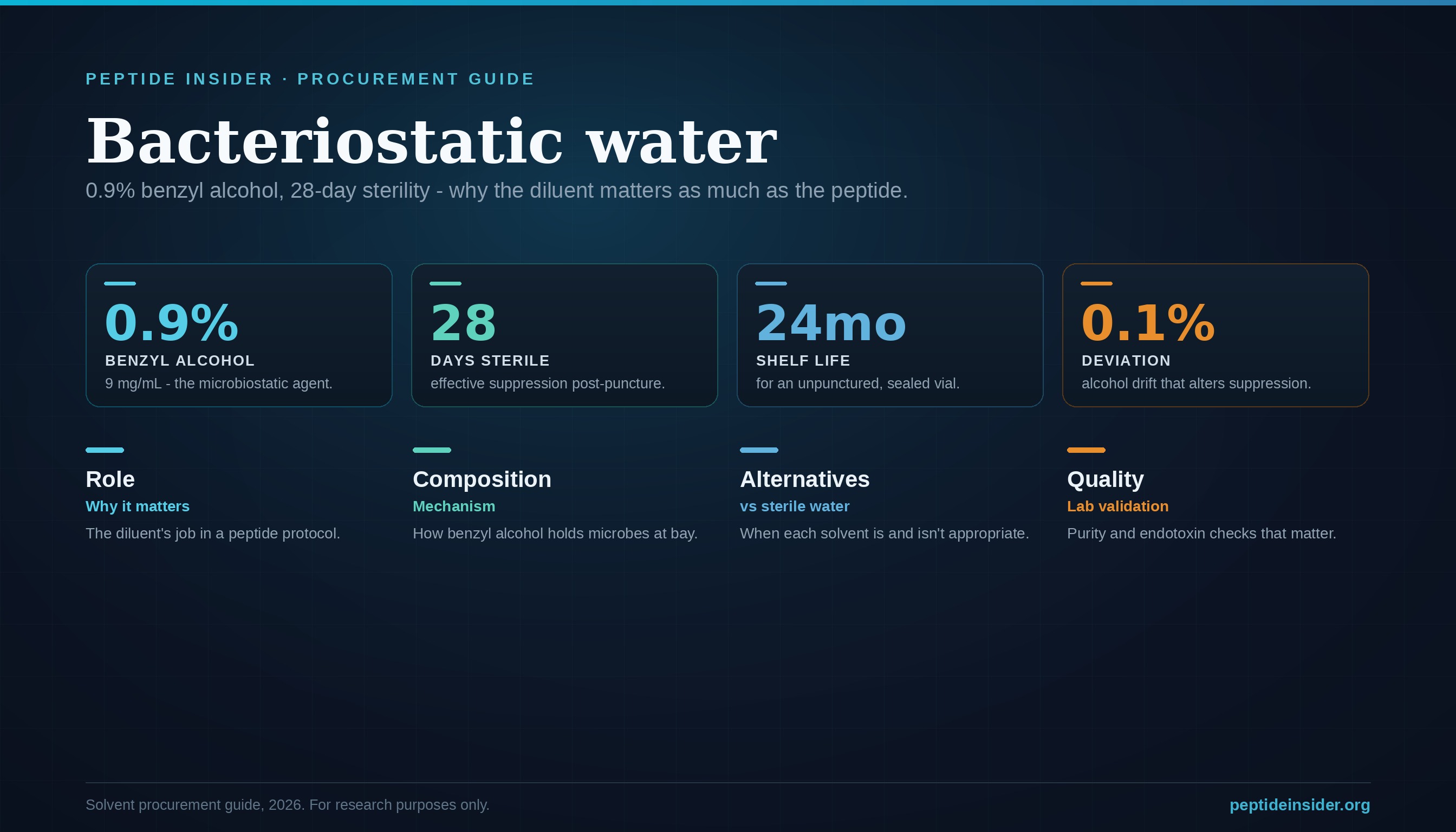
- Benzyl Alcohol Concentration: 0.9% (9 mg/mL)
- Microbial Suppression: Effective for up to 28 days post-puncture
- Endotoxin Threshold: Less than 0.25 EU/mL per 2026 research standards
- Primary Use: Reconstitution of multi-dose lyophilized compounds
Chemical Composition and Microbiostatic Mechanisms
The chemical profile of bacteriostatic water centers on its primary preservative agent, benzyl alcohol (C7H8O). While the base solvent is highly purified, sterile water, the addition of benzyl alcohol at a precise 0.9% concentration transforms the solution from a simple diluent into a microbiostatic environment. According to the Bacteriostatic Water for Injection, USP guidelines, this concentration is the pharmacological threshold required to suppress the metabolic activity of contaminating microorganisms without compromising the structural integrity of the dissolved compounds.
Benzyl alcohol exerts its effects by disrupting the bacterial cell membrane and subsequently inhibiting protein synthesis. It targets both gram-positive and gram-negative bacteria, effectively preventing their replication. It’s vital to distinguish this from a bactericidal action; the solution doesn’t necessarily kill existing bacteria but ensures that any introduced microbes cannot multiply. This mechanism is particularly effective for research peptides like GHK-Cu, where maintaining a sterile environment over several weeks is necessary for data consistency.
Solubility remains a critical factor in peptide research. The 0.9% benzyl alcohol concentration typically has a negligible impact on the solubility of most lyophilized powders. However, it can slightly lower the pH of the solution. This acidity must be accounted for when working with highly pH-sensitive sequences. Regarding shelf-life, an unpunctured vial typically remains stable for 24 months. Once the septum is breached, the 28-day rule applies. After this period, the preservative’s efficacy against ambient contaminants declines, necessitating the disposal of the remaining solvent.
Benzyl Alcohol: Safety and Efficacy in Research
Toxicological data indicates that benzyl alcohol concentrations exceeding 3% can lead to localized tissue necrosis or systemic toxicity in research models. The 0.9% cap is a rigorous standard that balances antimicrobial protection with biological safety. In a research-only context, this solvent is distinct from clinical-grade injections due to the potential for preservative accumulation over repeated exposures. For long-term studies, researchers must monitor the interaction between C7H8O and the peptide’s amino acid sequence to ensure that no oxidative degradation occurs during the 28-day window.
Pharmacokinetics of Solvent-Peptide Complexes
The purity of the solvent directly influences the bioavailability of the reconstituted peptide. High-purity bacteriostatic water prevents the formation of particulate matter that could trigger injection-site reactions or inflammatory responses in research subjects. By maintaining the peptide in a stable, monomeric state, the solvent ensures predictable absorption rates. As of 2026, the scientific consensus identifies bacteriostatic water as the definitive standard for multi-dose peptide stability in longitudinal research. Scientists seeking to optimize their laboratory protocols can find specialized guidance on solvent selection through peer-reviewed resources.

Comparative Analysis: Bacteriostatic Water vs. Alternatives
Selecting an appropriate diluent is a critical variable in peptide reconstitution that dictates the shelf-life and safety of the research material. While researchers often weigh the merits of sterile water, deionized water, and bacteriostatic water, these substances aren’t interchangeable. Sterile Water for Injection (SWFI) lacks a preservative, meaning it’s strictly for single-use applications. Once the vial’s seal is breached, the risk of microbial contamination increases exponentially within hours. Conversely, Bacteriostatic Water for Injection, USP contains 0.9% benzyl alcohol, which serves as a bacteriostatic agent to inhibit the proliferation of most susceptible bacteria. This makes it the standard for longitudinal protocols where a single vial must be accessed multiple times over a 28 day period.
Deionized water, though purified of mineral ions, isn’t suitable for peptide research because it lacks guaranteed sterility and appropriate osmotic pressure. Using it can lead to rapid peptide degradation or unpredictable experimental results. A common misconception in the research community is the feasibility of “DIY” bacteriostatic water. Attempting to mix benzyl alcohol with sterile water in a non-controlled environment introduces risks of pH imbalance and endotoxin contamination. Even a 0.1% deviation in alcohol concentration can compromise the peptide’s primary structure or cause localized irritation in animal models. Researchers managing complex multi-peptide budgets, such as those tracking retatrutide price fluctuations alongside solvent costs, understand that procurement inefficiencies compound quickly across a longitudinal study.
- Acute Studies: Sterile water is often preferred for 24 hour observations where preservative interference must be eliminated.
- Longitudinal Protocols: Bacteriostatic water is mandatory for multi-dose cycles to maintain sterile integrity.
- Bulk vs. Pre-filled: Purchasing 30ml pre-filled vials is more cost-effective than bulk laboratory supplies when factoring in the specialized equipment required for sterile decanting.
Solvent Selection Framework for Researchers
The complexity of a peptide sequence determines its solubility requirements. High-concentration peptides, particularly those exceeding 10mg/vial, often require larger solvent volumes to prevent gelling, a state where the peptide forms a gelatinous mass rather than a clear solution. Researchers should consult the Peptide Purity Lab Data to validate how specific solvents interact with various amino acid chains. If a sequence contains a high percentage of hydrophobic residues, a standard 1ml reconstitution might be insufficient, necessitating a graduated approach to solvent addition.
Storage and Handling Protocols
Maintaining the efficacy of the benzyl alcohol preservative requires strict adherence to environmental controls. Bacteriostatic water should be stored at controlled room temperatures, typically between 20 and 25 degrees Celsius. Exposure to direct UV light can catalyze the oxidation of the preservative, so using amber vials or dark storage containers is a standard requirement for long-term research. Expired solvents or those showing visible particulates must be discarded via biohazardous waste protocols to prevent cross-contamination in the laboratory environment. It’s vital to track the “beyond-use date” (BUD), which is 28 days after the initial vial puncture.
Evaluating Solvent Quality: Purity Standards and Lab Validation
Researchers often assume that all bacteriostatic water is functionally identical. This assumption ignores 2026 analytical data demonstrating that solvent purity varies significantly across different vendors. Substandard production environments introduce microscopic particulates that interfere with high-sensitivity assays. It’s a mistake to treat the solvent as a passive component. Impurities in the water can interact with the peptide’s molecular structure, leading to accelerated degradation before the research even begins.
A Certificate of Analysis (COA) isn’t just a formality; it’s a technical blueprint of the batch. You’ve got to scrutinize endotoxin levels with precision. In 2026, the industry standard for high-tier research requires endotoxin concentrations below 0.25 EU/mL. If the pH falls outside the 4.5 to 7.0 range, the bacteriostatic water might destabilize delicate peptide bonds through acid-base catalysis. Be wary of vendors providing HPLC reports dated more than six months prior to the current batch. Missing batch numbers suggest a total lack of traceability, which is a major red flag in procurement. Third-party testing for heavy metals like lead and mercury is non-negotiable for maintaining the integrity of longitudinal studies.
Identifying Reputable Solvents in the Research Market
Reputable vendors prioritize transparency over marketing. They provide accessible, batch-specific data rather than generic templates. While “medical grade” labels imply quality, they lack meaning in a research-only context without secondary validation. You can verify a vendor’s COA by cross-referencing the unique report ID within independent lab databases like Janoshik or MZ Biolabs to ensure the data hasn’t been tampered with or recycled from older batches.
The Risk of Substandard Solvents
Impure water doesn’t just fail to preserve; it actively destroys. Contaminants like dissolved oxygen or trace minerals can catalyze oxidation, mimicking peptide degradation and skewing your data. A 2025 internal study documented research failures where a pH drift of just 1.2 units led to the rapid deamidation of amino acid sequences. Peptide Insider provides these data points to ensure researchers don’t lose months of work to avoidable solvent failures. Our mission focuses on providing the transparency needed to prevent these technical setbacks.
Learn how to protect your sequences by reviewing our guide on procurement safety and vendor verification.
Optimizing Procurement: Finding High-Purity Water via PeptidePrice
Securing high-quality bacteriostatic water remains a logistical hurdle for researchers who prioritize analytical precision. In 2026, the market for research solvents has fragmented, leading to significant price disparities across vendors. PeptidePrice serves as a centralized intelligence hub, allowing researchers to bypass the arbitrary markups often applied to basic reagents. This data-driven approach ensures that laboratory budgets are allocated toward primary research objectives rather than inflated overhead costs. By monitoring price fluctuations, laboratories can maintain a consistent supply of essential diluents without compromising on purity standards.
Leveraging Market Data for Research Efficiency
The PeptidePrice platform aggregates real-time solvent costs from top-tier laboratory suppliers. By analyzing price-per-milliliter data, researchers can identify when vendors apply a “research tax” to bacteriostatic water simply because it’s bundled with high-margin peptides. Shipping logistics represent another critical cost variable. Because liquid shipments are heavy, the tool identifies vendors whose regional distribution centers offer the most efficient shipping protocols. Strategic bulk purchasing is recommended when data indicates a 15% or greater reduction in unit cost for orders exceeding 500ml, provided the laboratory’s throughput justifies the inventory hold. This systematic analysis prevents the common error of overpaying for standardized reagents. Laboratories that also monitor the retatrutide price trends in the 2026 market will recognize how vendor-level cost analysis applies equally to both complex peptides and essential ancillary supplies like bacteriostatic water. Researchers who require a more comprehensive framework for evaluating vendor pricing across multiple compounds can benefit from using a peptide price comparison tool to benchmark solvent and compound costs against current market data simultaneously.
The Peptide Insider Advantage
Membership provides access to a database of verified vendors, which is essential for maintaining the chain of custody for research supplies. Our community data tracks vendor reliability, helping researchers avoid “ghost vendors” that emerged during the supply chain shifts of 2024 and 2025. This oversight ensures that the bacteriostatic water procured meets the 0.9% benzyl alcohol USP standard required for multi-dose vial stability. Join the Peptide Insider Club to access the full comparison tool and secure exclusive discounts on essential solvents. Accessing these verified channels minimizes the risk of receiving sub-standard reagents that could jeopardize experimental outcomes.
- Confirm USP grade certification and 0.9% benzyl alcohol concentration for all vials.
- Analyze the price-per-milliliter across at least three verified vendors on the PeptidePrice dashboard.
- Evaluate the total landed cost, accounting for shipping weight surcharges for bulk liquid volumes.
- Verify the vendor’s most recent batch testing date to ensure the reagent provides maximum shelf-life for long-term studies.
- Cross-reference vendor reviews within the Peptide Insider community to verify recent shipping performance and packaging integrity.
Advancing Research Integrity through Standardized Solvent Procurement
Maintaining the chemical stability of synthetic peptides requires a rigorous approach to solvent selection. The 2026 pharmacological landscape emphasizes that using a high-purity preservative-based diluent isn’t just a preference; it’s a requirement for preventing microbial proliferation during multi-dose research protocols. By utilizing a 0.9% benzyl alcohol solution, researchers extend the shelf life of reconstituted compounds for up to 28 days under refrigerated conditions. This stability ensures that experimental data remains untainted by degradation or contamination.
Achieving these standards requires access to transparent supply chains. It’s essential to verify every batch through independent lab reports to confirm that purity levels meet the 99.9% threshold required for advanced biochemical analysis. Navigating the current market requires data-driven tools that prioritize vendor accountability over marketing claims.
Find the best market rates for bacteriostatic water using the PeptidePrice Tool to access independent 2026 price data and our verified vendor COA database. You’ll also receive exclusive researcher-only SMS and email alerts to stay ahead of supply shifts. Precision in procurement is the first step toward breakthrough results in your laboratory.
Frequently Asked Questions
How long does bacteriostatic water last once the vial is punctured?
Can I use bacteriostatic water for all research peptides?
What is the difference between bacteriostatic water and bacteriostatic sodium chloride?
Why does bacteriostatic water contain benzyl alcohol?
Is it safe to freeze bacteriostatic water for long-term storage?
Can I reconstitute peptides with sterile water if I use the entire vial immediately?
What should I do if my bacteriostatic water appears cloudy?
Where is the best place to buy bacteriostatic water in 2026 for research purposes?
References
- Liu M, Svirskis D, Proft T, et al. Progress in peptide and protein therapeutics: Challenges and strategies. Acta Pharm Sin B. 2025;15(12):6342-6381. PubMed
Leave a Reply