
Quick Summary
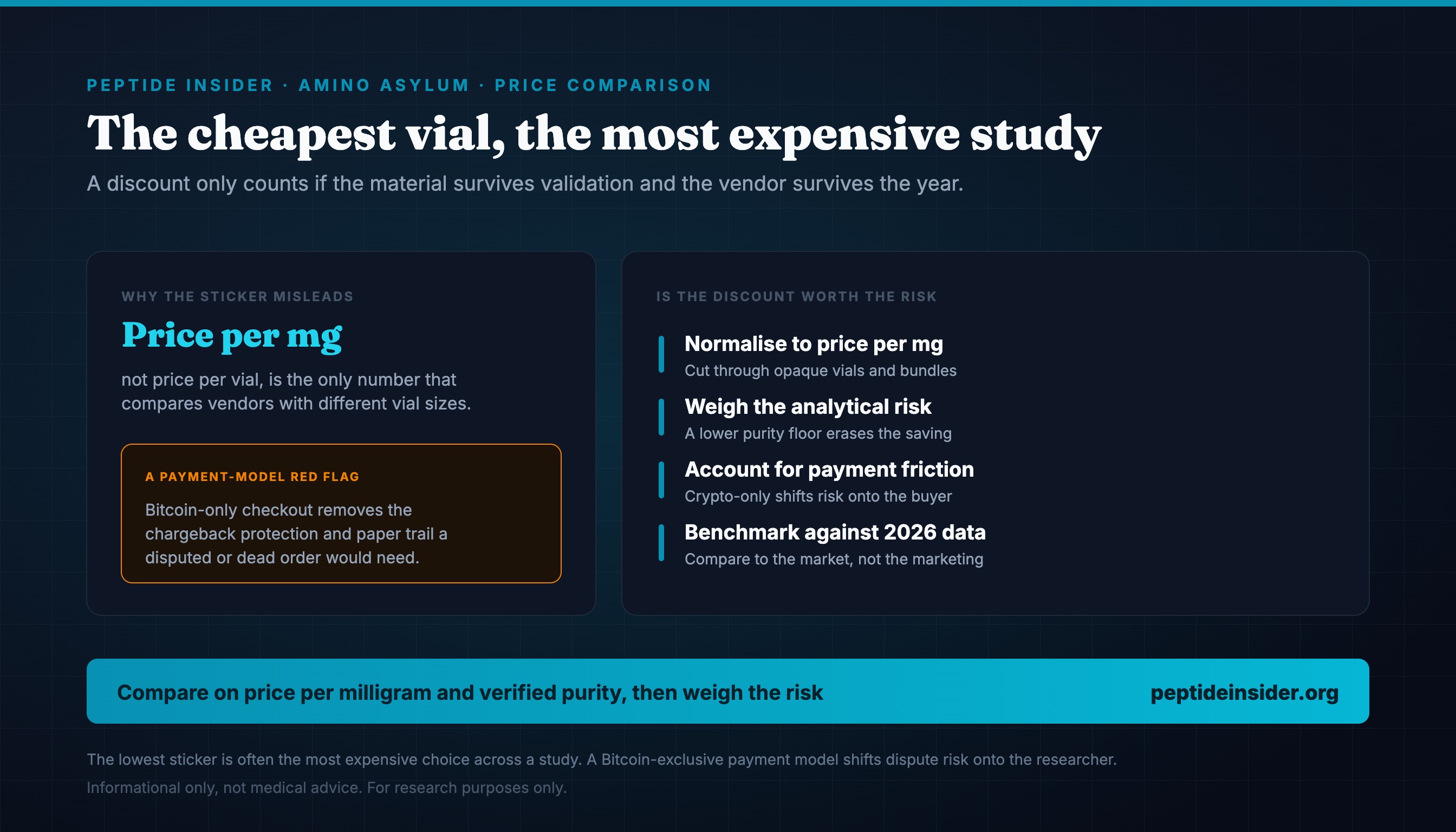
For research peptides, the lowest sticker price is often the most expensive choice over the life of a study, because true efficiency depends on price-per-milligram and verified purity rather than the headline cost of a vial. This report compares Amino Asylum’s pricing against 2026 industry benchmarks, using a price-per-milligram framework to cut through opaque vendor pricing and disparate vial sizes. It weighs whether the vendor’s discounts are worth the analytical risk, considers the implications of Bitcoin-exclusive payment models, and shows how automated comparison tools help optimize laboratory procurement without sacrificing reagent quality.
The lowest sticker price on a peptide vial often represents the most expensive path for a laboratory’s longitudinal budget. While a $11.99 unit of GHRP-2 might suggest immediate savings, the actual fiscal efficiency of a compound is determined by its price-per-milligram (PPM) and verified purity levels rather than the initial transaction cost. You’re likely familiar with the frustration of navigating opaque vendor pricing and the tedious manual calculations required to compare disparate vial sizes. It’s a persistent challenge to balance the pursuit of high-purity reagents with the constraints of a finite research budget.
This report offers a meticulous examination of how amino asylum peptide prices compared against 2026 industry standards, providing the objective data needed to optimize your procurement strategy. We’ll analyze current figures, such as the $34.99 price point for 5mg of BPC-157, alongside the systemic implications of Bitcoin-exclusive payment models and free shipping thresholds. You’ll gain a robust framework for calculating true research value and learn how the Peptide Insider Price Comparison Tool can automate your market surveillance. By moving beyond surface-level costs, you can ensure that your laboratory’s resources are allocated with maximum precision and scientific integrity.
Key Takeaways
- Identify how Amino Asylum occupies a high-volume, budget-conscious niche within the 2026 US market for both foundational and complex peptide sequences.
- Master the Price-Per-Milligram (PPM) framework to bypass the ambiguity of varying vial sizes and calculate the actual fiscal impact on your laboratory budget.
- Analyze how amino asylum peptide prices compared to Tier 1 domestic benchmarks and international bulk sources to determine the most efficient procurement strategy.
- Evaluate the critical trade-offs between aggressive pricing and the frequency of analytical validation via HPLC and Mass Spectrometry testing.
- Learn to utilize the Peptide Insider Price Comparison Tool to automate market surveillance and aggregate real-time data from over 20 reputable research vendors.
Amino Asylum in the 2026 Research Peptide Market
Amino Asylum has carved out a distinct high-volume territory within the United States research peptide sector. By May 2026, the vendor has solidified its reputation as a price leader, prioritizing high inventory turnover and competitive accessibility. Their inventory reflects this strategy, offering between 18 and 24 distinct peptide products. This catalog ranges from foundational repair molecules like BPC-157, currently listed at $34.99 per 5mg, to more advanced metabolic sequences. Their operational model, which includes US-based manufacturing and a decade of market presence, positions them as a specialized guide for researchers navigating complex procurement landscapes.
When amino asylum peptide prices compared are analyzed against the broader market, it’s evident they serve as a critical baseline for budget-conscious researchers. The complexity of the peptide synthesis process inherently dictates the floor for pricing. Amino Asylum often sits near this floor, attracting independent investigators who require substantial volume for preliminary screening phases. This economic positioning is further reinforced by their shipping policies, such as free shipping on orders exceeding $150, which incentivizes bulk procurement for larger cohorts.
Historical Price Stability and Market Trends
Over the past 24 months, Amino Asylum has demonstrated notable price resilience despite global inflationary pressures. While raw material sourcing costs have fluctuated, staple compounds like CJC-1295 have maintained a relatively stable MSRP, currently listed at $35.00. The vendor’s strategy relies on high-frequency sales rather than permanent price reductions. For example, CJC-1295 reflects a reduction from an original $40.00 price point, a trend seen across several of their metabolic agents. Even ancillary items like Bac Water ($9.99 for 20ml) and Acetic Acid ($4.99 for 20ml) remain consistently priced to support high-volume laboratory throughput. This stability makes the platform a reliable variable when amino asylum peptide prices compared are used to forecast annual laboratory expenditures.
The Budget-Researcher Archetype
The typical researcher utilizing Amino Asylum often operates outside large institutional grants. These investigators prioritize aggressive price points to maximize their laboratory’s reach. There’s a calculated trade-off involved. While the vendor claims purity levels exceeding 99% verified by HPLC and mass spectrometry, the lower cost-of-entry compared to Tier 1 providers requires researchers to be more diligent with their analytical validation. The exclusive use of Bitcoin for payments further defines this archetype, appealing to researchers who are already integrated into alternative financial systems for their chemical procurement needs. Community feedback remains a primary driver for validating these price-to-value ratios in real-time, ensuring that scientific rigor is maintained despite the lower capital requirements.
Calculating the True Cost: Price-Per-Milligram (PPM) Framework
Evaluating research reagents based on their nominal vial price frequently leads to fiscal inaccuracies in laboratory planning. A vendor may list a 2mg vial at a lower entry point than a 5mg or 10mg alternative, yet the unit cost often reveals a significant premium on smaller quantities. Price-Per-Milligram (PPM) constitutes the only objective metric for evaluating peptide procurement efficiency. By applying the fundamental equation of Total Price divided by Total Milligrams, researchers can bypass the psychological anchoring of low sticker prices to identify the most sustainable source for their specific protocols.
When amino asylum peptide prices compared are subjected to this PPM framework, the variance across different sequences becomes immediately apparent. Beyond the raw powder cost, researchers must also account for reconstitution volume and the inevitable residual waste within syringe dead spaces, which effectively raises the realized PPM. A 10% loss during the transfer process can shift the economic viability of a study. It’s essential to factor in these operational variables during the budgeting phase to maintain a consistent longitudinal data set without unexpected capital depletion.
Case Study: BPC-157 and Semaglutide Value Analysis
Analyzing the $34.99 price point for 5mg of BPC-157 yields a PPM of approximately $7.00. This figure sits comfortably below many Tier 1 domestic competitors who often price similar quantities significantly higher. Conversely, the $124.99/5mg Semaglutide offering requires a more nuanced comparison against boutique vendors who may offer higher transparency regarding batch-specific purity. Identifying the “sweet spot” in the catalog involves balancing these PPM figures against the stability of the compound; larger vials may offer better value but risk degradation if the research timeline extends beyond the peptide’s reconstituted shelf life.
Hidden Costs: Shipping, Handling, and Payment Fees
Total Delivered Cost represents the final metric for laboratory budgeting. Amino Asylum’s policy of free shipping on orders exceeding $150 significantly reduces the PPM for high-volume procurement, whereas smaller orders must absorb shipping overhead that can skew the value proposition. Additionally, the requirement for Bitcoin payments introduces a variable cost based on transaction fees and exchange rate volatility. Utilizing Peptide Insider resources allows researchers to track these shifting variables in real-time, ensuring that the initial amino asylum peptide prices compared remain accurate at the point of transaction.

Amino Asylum vs. Industry Benchmarks: A Comparative Analysis
Benchmarking Amino Asylum against Tier 1 domestic vendors reveals a consistent pricing divergence that often reaches 40% to 60% for staple compounds. While premium organizations justify higher premiums through more frequent, batch-specific third-party verification, Amino Asylum utilizes a high-volume model to maintain aggressive accessibility. When amino asylum peptide prices compared are viewed alongside international bulk sourcing, the vendor occupies a strategic middle ground. They offer the logistical security of US-based manufacturing and domestic shipping without the extreme overhead associated with boutique analytical firms, making them a primary choice for labs requiring high-quantity reagents.
The “Value Gap” emerges as a critical consideration for researchers weighing lower price points against analytical rigor. Although Amino Asylum maintains that their products exceed 99% purity verified by HPLC and mass spectrometry, the lower cost-of-entry suggests a different operational focus than vendors who provide exhaustive, real-time documentation for every individual vial. This price-to-purity ratio is the primary variable in determining whether a discount represents true research value or a potential risk to data reproducibility. Deciding where to allocate a budget depends on the specific sensitivity of the research protocol and the necessity for redundant verification layers.
Standard Research Compounds: The Price Leaders
Growth Hormone Secretagogues (GHS) represent Amino Asylum’s most dominant market niche. Current data indicates that compounds like GHRP-2 and GHRP-6 are priced at $11.99 per 5mg, while Ipamorelin is available for $19.99 per 2mg. These figures are significantly lower than the $30.00 to $50.00 range often seen at Tier 1 suppliers. Furthermore, researchers evaluating the price-to-purity ratio for high-demand compounds like GHK-Cu will find that Amino Asylum consistently positions itself at the lower end of the domestic spectrum, allowing for larger cohort sizes in preliminary screening phases.
Newer Sequences: The Premium Pricing Tier
The 2026 research landscape has seen the introduction of high-complexity sequences such as Retatrutide and Cagrilintide into the Amino Asylum catalog. These newer molecules typically command a premium during their initial launch phase due to the intricacies of the synthesis process and limited raw material availability. As amino asylum peptide prices compared to earlier sequence launches show, volatility is high during the first 12 months of a compound’s availability. Sequence complexity directly correlates with price stability; more intricate chains require sophisticated purification protocols that prevent the rapid price normalization seen in simpler, foundational peptides.
Analytical Validation: Is the Discount Worth the Risk?
Analytical rigor is the primary casualty in aggressive price competition. High-performance liquid chromatography (HPLC) and mass spectrometry (MS) serve as the essential guardians of research integrity, providing the empirical data required to verify molecular identity. Premium vendors frequently provide batch-specific documentation for every production run; conversely, high-volume distributors often rely on representative testing to sustain their economic models. This disparity creates a “Trust Tax.” Many institutional investigators pay a 30% premium to Tier 1 suppliers to eliminate the risk of batch-to-batch variance. If an independent researcher decides to verify a budget vial, the standard analytical fee of $200 to $400 per sample typically negates any upfront savings. When amino asylum peptide prices compared are analyzed, the frequency of their Certificate of Analysis (COA) updates remains a critical variable for longitudinal study stability.
Validation costs money. A $12.00 vial isn’t a bargain if its contents fail to align with the label. Researchers must determine if the price-to-risk ratio fits their specific protocol’s sensitivity.
Interpreting Purity Claims (98% vs. 99%+)
A purity shift from 98% to 99.5% may seem negligible. It isn’t. In sensitive biological systems, that 1.5% margin represents unknown synthesis byproducts or residual solvents that can compromise data reproducibility. Amino Asylum positions its catalog at a >99% purity threshold, which aligns with standard research requirements. However, researchers should consult the Peptide Purity Lab Data guide to understand how these thresholds impact specific systemic interactions. Precision requires verified data, not just marketing claims.
Red Flags in Budget Peptide Procurement
Suspiciously low pricing often signals systemic issues. Patterns of extreme discounting may suggest under-dosing or inconsistent vial-to-vial fill accuracy. These discrepancies introduce unwanted variables into a study, potentially skewing results. Researchers should utilize the Peptide Vendor Reviews guide to cross-reference community-led testing results with vendor claims. Maintaining a skeptical approach to budget procurement is essential for preserving the integrity of your findings. You can monitor these quality-to-price shifts through the Peptide Insider Price Comparison Tool to ensure your lab budget is spent on viable reagents.
Automating Your Price Comparison with Peptide Insider
Manual market surveillance is an inefficient use of laboratory resources. While researchers often attempt to track vendor shifts through bookmarks and spreadsheets, the volatility of the research chemical market in 2026 makes these methods obsolete. When amino asylum peptide prices compared are tracked manually, the researcher often misses the transient windows of peak fiscal efficiency. The Peptide Insider Price Comparison Tool solves this by aggregating real-time data from Amino Asylum alongside 20 other reputable research vendors. This centralized dashboard allows for an immediate, side-by-side analysis of market positioning, ensuring that every procurement decision is backed by current evidence rather than historical assumptions.
Precision in budgeting is just as critical as precision in the laboratory. High-value compounds like Tirzepatide or Retatrutide often exhibit the most significant price variance across the domestic landscape. By setting automated price alerts within the tool, you can receive notifications the moment a specific compound hits your target price-per-milligram threshold. This proactive approach eliminates the need for daily site visits and ensures you’re positioned to secure high-demand sequences before inventory depletion occurs. Accessing this level of market intelligence transforms procurement from a reactive task into a strategic advantage.
Leveraging Data for Strategic Procurement
Analytical decision-making requires historical context. By observing the pricing trajectories of metabolic agents over several quarters, researchers can predict when Amino Asylum is statistically likely to initiate seasonal sales or inventory clearances. Utilizing the Peptide Price Comparison Tool allows you to find the lowest PPM in seconds, bypassing the marketing layers of various storefronts. For those managing complex titration protocols, integrating this price data with the Peptide Calculator ensures that your projected dosing costs remain accurate to the cent, preventing mid-study budget shortfalls.
Join the Peptide Insider Community
The Peptide Insider Club functions as an analytical collective where data transparency is the primary objective. Members provide a vital feedback loop, flagging vendor issues, shipping delays, or sudden purity shifts that automated scrapers might miss. This human-verified data adds a layer of qualitative security to the quantitative price metrics. Subscribers gain exclusive access to SMS updates for flash sales and limited-edition research batches, providing a first-mover advantage in a competitive procurement environment. Don’t leave your laboratory budget to chance. Access the Peptide Insider Price Comparison Tool Today and join a community dedicated to scientific and fiscal rigor.
Optimizing Laboratory Procurement for 2026
Navigating the research peptide market requires a shift from observing nominal sticker prices to analyzing longitudinal fiscal efficiency. We’ve established that the Price-Per-Milligram framework is the only objective method for determining value; this is particularly evident when amino asylum peptide prices compared are weighed against Tier 1 domestic benchmarks. While the aggressive pricing models of high-volume vendors offer significant savings for preliminary screening, they necessitate a corresponding increase in analytical skepticism regarding purity thresholds and the frequency of batch-specific validation. Balancing these variables is essential for maintaining both budgetary integrity and scientific reproducibility.
To maintain this level of precision without the burden of manual tracking, researchers must adopt automated market surveillance. Our proprietary price-per-milligram tracking software aggregates independent data across 20+ reputable vendors, providing a centralized dashboard for real-time decision-making. Don’t leave your laboratory’s fiscal health to chance. Join the Peptide Insider Club for Real-Time Price Comparisons to access these tools and receive exclusive SMS market alerts for high-value sequences. Empowering your laboratory with data-driven insights ensures that every procurement cycle contributes to the advancement of your research objectives.
Leave a Reply