

Evidence-first peptide coverage — the claims on this page are linked to their primary sources and reviewed against our editorial policy
Citations verified against PubMed · Published: 2026-04-08 · Last updated: 2026-09-15 · For educational purposes · research compounds, not medicine
The GLOW peptide is one of the most heavily discussed peptide blends in the skin, appearance and recovery communities.
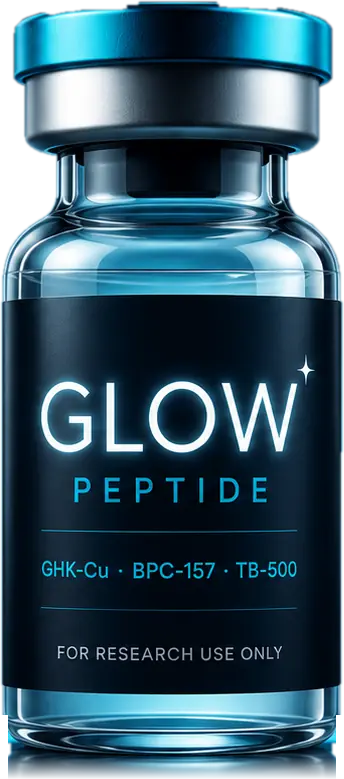
But GLOW is not actually one peptide. It is a nickname for a blend of GHK-Cu, BPC-157 and TB-500. Each compound has been researched on its own, to very different depths, but we found no controlled human trial of the three-compound GLOW formulation itself.
Online you will see before-and-after photos, skin transformations, hair-growth stories and recovery claims. This page separates what people are reporting from what has actually been demonstrated — with the photos reproduced and their sources linked, and every study linked.
Quick Answer: What Is GLOW Peptide?
GLOW is a three-compound research blend of GHK-Cu, BPC-157 and TB-500. The interest in the potential skin benefits comes almost entirely from GHK-Cu, which has human data from topical products and a small randomized trial (PMID 16847171, PMID 42619529). BPC-157 and TB-500 are discussed for tissue repair on the strength of animal work; a 2025 systematic review found one clinical BPC-157 study among 36 and no clinical safety data (PMID 40756949). We found no study of the blend itself, and the before-and-after posts with the most traction are not part of official trials, GLOW alongside another compound, or a timeframe with nothing else disclosed.
| Compound | Why it’s included | Human evidence |
|---|---|---|
| GHK-Cu | Skin, collagen and tissue-remodeling research | Topical products and a 13-patient randomized trial; one 2026 systematic review counted 2 RCTs among 20 studies (PMID 42619529) |
| BPC-157 | Experimental tissue-repair research | Three small pilot studies; no controlled trial that we could find; “no clinical safety data” in the 2025 systematic review (PMID 40756949, PMID 40789979) |
| TB-500 | Experimental cell-migration and tissue-recovery research | Human trials exist for the full thymosin β4 protein, not the TB-500 fragment sold in vials (PMID 41966639) |
What Is in the GLOW Peptide Blend?
As sold by the vendor we checked and as described in community explainers, GLOW means GHK-Cu + BPC-157 + TB-500. It may be sold as one pre-mixed vial or discussed as three individual compounds used as a stack. The standard vial is 70 mg, and tested lots come out at roughly 50 mg GHK-Cu, 10 mg BPC-157 and 10 mg TB-500 — so about 70% of what is in the syringe is the copper peptide.
GHK-Cu
GHK-Cu is the ingredient that makes the strongest scientific case for GLOW’s association with skin. It is a naturally occurring copper-binding tripeptide whose blood levels decline with age, studied for its effects on collagen, elastin and glycosaminoglycan synthesis, extracellular-matrix remodeling and fibroblast activity (PMID 26236730, PMID 29986520).
Important: topical GHK-Cu research does not prove that an injectable GLOW blend produces the same effects. The human studies applied the peptide to the face; GLOW goes under the skin somewhere else. Our GHK-Cu page and full GHK-Cu review go through the studies one by one.
BPC-157
BPC-157 is an experimental peptide commonly discussed for tissue repair. Most of the enthusiasm comes from laboratory and animal research rather than controlled human trials: a 2025 systematic review found 35 preclinical studies and one clinical study, and reported that no clinical safety data were found (PMID 40756949); a second 2025 review counts three human pilot studies in total and calls the compound investigational (PMID 40789979). FDA’s own review scientists recommended against adding BPC-157 to the 503A compounding list in July 2026, citing gaps in safety, efficacy and characterization, before the advisory committee voted the other way — our report on the vote has the detail. See also our BPC-157 page.
TB-500
TB-500 is sold as a fragment of thymosin β4, a 43-amino-acid protein. The human data — intravenous studies in healthy volunteers where adverse events were infrequent and mild to moderate (PMID 20536472), and a topical ulcer trial where safety was comparable to placebo (PMID 20536470) — belong to the full protein, not the fragment. A 2026 Sports Medicine review draws that distinction explicitly and notes that rigorous human safety data for the unapproved peptides it covers, TB-500 among them, are scarce (PMID 41966639). TB-500 was also among the peptides FDA reviewers recommended against in July 2026. Our TB-500 page covers what the fragment does and does not inherit.
KEY TAKEAWAY
Three peptides with three different evidence bases share one vial. When you read a GLOW claim, ask which component it belongs to — and whether that component has ever been studied by the route people are actually using.
What Does GLOW Peptide Do?
Online discussion around GLOW falls into three categories: skin appearance, including texture and complexion; hair, including shedding and new growth; and recovery, because BPC-157 and TB-500 are staples of the tissue-repair communities.
These areas are not equally well supported. The most substantial scientific rationale involves GHK-Cu and skin biology. The recovery claims rest on animal data for the other two peptides. We found no study of the combined GLOW blend — the individual-ingredient studies are what people mean when they say GLOW “has research behind it.”
GLOW Peptide Before and After: What Are People Actually Seeing?
We collected the before-and-after posts the community itself has judged — the ones with hundreds of upvotes or likes and long comment threads — and reproduced the photos below with the source linked under each. Nothing has been retouched or relabeled; where a post is not actually a GLOW result, we say so.
Note: these are community-reported results, not controlled clinical evidence. Lighting, skincare, weight change, other compounds, camera processing and concurrent treatments all affect a comparison. Each set below has at least one of those problems, and the bullet under it names it.
Example #1 — 5-Month Skin Update (Before and After Results)

- Source: r/BodyHackGuide, September 2026 — 500+ upvotes, 100+ comments. The poster describes five years of adult acne and five months on GHK-Cu by itself, with two breaks, and says nothing about BPC-157 or TB-500. It is the most-upvoted copper-peptide skin post we came across, and although GLOW is about 70% GHK-Cu – suggesting that the full blend may not be necessary . The photos show fewer visible blemishes and a more even complexion, but acne fluctuates with hormones, skincare, diet and season, and even for GHK-Cu alone the pictures cannot establish cause.
Example #2 — One Month on GLOW

- Source: r/BodyHackGuide, January 2026 — 300+ upvotes, 87 comments. The poster started retatrutide and the GLOW stack at the same time and stopped both after about a month, crediting GLOW with less inflammation, skin elasticity, a hydrated look and faster hair growth, and retatrutide with a more toned appearance. A month is short for structural skin change — the GHK-Cu studies that measured anything looked at 12 weeks (PMID 16847171) — the two photos appear to come from different settings and lighting, and a second active compound that changes body composition, and with it the face, was running the whole time.
Example #3 — 28 Days on the “Glow Stack” (TikTok)

- Source: TikTok, May 2026 — a short before-and-after whose on-screen text reads “28 Days On Glow Stack”; 164 likes and 14 comments when we checked. The later still appears more even in tone with fewer visible dark spots. Twenty-eight days is a short window for pigment or texture change, the two frames are lit differently, and the video gives no information about skincare, sun exposure, makeup or anything else used during the month, so this is an anecdote with one data point.
Example #4 — One Week vs. One Month on GLOW (TikTok)

- Source: TikTok, June 2026 — a 12-second clip the creator captions as a before and after of glow peptide; 674 likes and 96 comments when we checked. The one-month frame appears to show less redness and a calmer complexion than the one-week frame. Note that the “before” is already a week into GLOW, the backgrounds, lighting and grooming differ substantially, and nothing else the creator was doing is disclosed — so the comparison cannot attribute the change to GLOW.
The photos above are reproduced from public posts for commentary and criticism, cropped only to remove platform interface, with the original post linked under each. If you appear in one and would like it removed, email contact@peptideinsider.org and we will take it down.
PERSONAL OBSERVATION — PI EDITORIAL
Of the four photo sets with real traction, one is GHK-Cu alone, one ran GLOW alongside retatrutide, and the two TikTok pairs disclose nothing beyond a timeframe. The longest GLOW thread we found — twelve weeks, four photos, 350+ upvotes — is a GLP-3 weight-loss post in which the poster describes the GLP-3 dose and the gym routine and mentions GLOW only in the title (thread). We could not find a well-documented photo set of GLOW by itself, at least within the hundred most relevant threads of the past year that we read.
GLOW Peptide Results Timeline
There is currently no clinically validated GLOW peptide results timeline. The table summarizes how timelines are described in the threads we read, not an established schedule.
| Time | What people commonly report | Evidence level |
|---|---|---|
| Days to 2 weeks | Joint and soreness relief — the fastest and most consistent reports (thread) | Anecdotal |
| Weeks 2–6 | First skin comments: hydration and elasticity at about four weeks (thread), first skin improvements at two to three weeks for some (thread) | Anecdotal |
| Weeks 6–12 | Where posters place visible skin change; where the GHK-Cu studies took their measurement (PMID 16847171, PMID 27064823) | Limited (component only) |
| 3–6 months | Longer skin and hair reports; the one 5-month photo set is GHK-Cu alone, and the one hair photo set is a KLOW user with three confounders (see Hair) | Very limited |
The human studies of topical GHK-Cu evaluated outcomes at roughly 12 weeks. That does not establish an injectable GLOW timeline, but it does mean the only human measurements were taken three months in, not days.
GLOW Peptide for Skin
This is where the rationale behind GLOW is strongest, although the supporting evidence comes from GHK-Cu, not the blend. GHK-Cu has been studied for its interactions with fibroblasts, collagen, elastin and other components of skin remodeling (PMID 29986520).
The randomized controlled study we could retrieve in full is instructive. Thirteen patients completed a study in which, after CO2 laser resurfacing, they were randomized to skin-care regimens with or without GHK-Cu; at 12 weeks all patients had improved in wrinkles and skin quality, but blinded evaluators found no significant difference between the GHK-Cu group and controls — only patient satisfaction was higher with the peptide (PMID 16847171). Everyone improved; the peptide group was surer they had. That pattern governs how you should read every GLOW skin post.
GLOW Peptide for Fine Lines and Skin Texture
Elasticity, hydration and overall complexion are the changes posters describe most (thread, thread); fine lines are where the GHK-Cu literature itself has looked. GHK-Cu has been investigated for collagen production and dermal remodeling — a single-patient case report of a device-assisted solution containing GHK-Cu alongside four other cosmetic ingredients documented a decrease in crow’s feet and increased collagen on biopsy after 12 weekly treatments (PMID 27064823) — but controlled evidence for the injectable GLOW blend is lacking. Our peptides for wrinkles page compares the options.
GLOW Peptide for the Face and Under-Eyes
Face and under-eye comparisons are common because subtle differences in fine lines and texture are easy to notice there. Both human GHK-Cu studies we found treated the face, but under-eye photographs are particularly sensitive to lighting, expression, makeup, hydration and — as the 12-week retatrutide thread shows — weight.
GLOW Peptide for the Neck
The neck is another frequently photographed area. We found no study that examined GHK-Cu, GLOW or any component on neck skin specifically, so these comparisons should be treated as individual reports rather than expected outcomes. See peptides for aging skin for what has been measured.
GLOW Peptide for Hair
Hair is one of the most discussed extensions of the GLOW topic and one of the easiest to overstate. The interest comes from GHK-Cu, and the nearest published evidence is not GLOW: an open-label, single-arm study of 1,000 patients given scalp injections of a growth-factor cocktail that included copper tripeptide-1 and thymosin β4 reported that 83% had reduced hair fall on a pull test and that total hair count increased at one year (PMID 29482481). It had no control group and four other active ingredients (VEGF, bFGF, IGF and KGF).
Online reports describe faster hair growth (thread) and thicker-looking hair (the KLOW thread below). In the GLOW threads we read for this page we found no hair-specific photo set for GLOW alone; the widely shared hair thread in the peptide communities is a KLOW user who was also on finasteride and two other peptides and had lost 100 kg (thread). Hair growth is slow, so meaningful comparisons need months, and our hair-growth peptides guide sets out what a fair comparison looks like.
Does GLOW Peptide Actually Work?
The most accurate answer is: the individual ingredients have different levels of evidence, and we found none for the GLOW combination itself.
Evidence for GHK-Cu
GHK-Cu has the strongest skin-related research base of the three. The literature covers collagen signaling, fibroblast activity, elastin, glycosaminoglycans, skin remodeling and wound healing across cell, animal and small human studies (PMID 26236730, PMID 29986520). The 2026 systematic review found that, clinically, GHK-Cu improved patient satisfaction after laser resurfacing and reduced wrinkle volume and depth versus controls — while calling for larger controlled trials with standardized formulations (PMID 42619529). The human studies we could identify are all topical or device-assisted.
Evidence for BPC-157
BPC-157 has a large internet reputation and a small human evidence base. Of 36 studies in the 2025 systematic review, 35 were preclinical; the single human series was a retrospective knee-pain report in which 7 of 12 patients had relief beyond six months after an intra-articular injection (PMID 40756949). A second 2025 review reports no adverse effects in the three human pilots and states plainly that rigorous, large-scale trials are lacking (PMID 40789979).
Evidence for TB-500
Human evidence for the TB-500 fragment is the thinnest of the three. The trials belong to the full thymosin β4 protein, given intravenously or topically, and the 2026 review that separates the two says rigorous human safety data for the unapproved peptides it covers are scarce (PMID 41966639).
Has the GLOW Blend Itself Been Studied?
No. This distinction is crucial: a study of GHK-Cu is not evidence for GHK-Cu + BPC-157 + TB-500. Studying three ingredients separately does not show that they work better together, that they are safe together, that the popular 50/10/10 ratio is optimal, or that the combined formulation produces the transformations shown online. We found no experiment behind the blend’s proportions; they appear to be a vendor convention.
Real GLOW Peptide Reviews and Community Experiences
Much of GLOW’s popularity is driven by Reddit and other peptide communities. Everything below is paraphrased and linked to its thread; we do not name posters.
- The timeline thread (r/Peptides, January 2026, 56 comments): the most consistent reports are musculoskeletal — a frozen shoulder moving without pain within a couple of weeks, achy post-lift joints better within seven to ten days, knee pain from a torn meniscus easing inside a week. Skin change is placed later: two to three weeks for first improvements by some, six to eight weeks or two to three months by others.
- The explainer Google ranked first on September 15, 2026 (r/ScienceBioTechnology, August 2026): a 70 mg vial in a 50/10/10 split, why it is blue, and the per-component literature — a useful primer that is, correctly, a summary of ingredient studies rather than blend studies.
- The energy thread (r/Biohacking, June 2026, 52 comments): a poster who felt unusually recharged after two nights of use and, in their own words, allowed it could be placebo; the top reply told them to enjoy it either way.
- The 12-week retatrutide thread (r/Retatrutide, June 2026, 100+ comments): 30 lb lost in 12 weeks on retatrutide with GLOW in the title, four photos, a visible change in face shape, and a top comment praising the skin. The body of the post describes the retatrutide dose and a five-day-a-week lifting routine and does not describe the GLOW use at all — the clearest example of why GLOW before-and-afters are hard to read.
- The side-effect threads are covered below.
These reports are useful for understanding what users experience and ask about, but they are not a substitute for a trial. The most useful ones disclose a clear timeline, photographs, everything else the person was taking, and both positive and negative outcomes — which is exactly why the three photo threads above are worth reading in full.
GLOW Peptide Side Effects and Safety
There is no controlled safety trial of the GLOW combination. In July 2026, FDA’s review scientists recommended against adding BPC-157 and TB-500 to the 503A compounding list, citing gaps in safety and efficacy data and in characterization of the molecules, although the advisory committee then voted to recommend both; GHK-Cu is queued for review before February 2027 (our report).
Claims that GLOW has “no side effects” are therefore unsupported. A more accurate statement is that the safety profile of the combined GLOW formulation has not been established. What the components offer: the full thymosin β4 protein was well tolerated intravenously in healthy volunteers (PMID 20536472); BPC-157’s three human pilots reported no adverse effects while the systematic review found no clinical safety data (PMID 40789979, PMID 40756949); the device-assisted case report (GHK-Cu with four other ingredients) noted no adverse effect in its one patient (PMID 27064823).
What users report: injection-site stinging that posters attribute to unbound copper (thread); four to five days of sleep disruption and vivid dreams in one poster, which the top reply attributed to an illness that coincided with travel (thread); palpitations and rising anxiety in the first days in another, which a commenter attributed to BPC-157 (thread); and injection pain that replies put down to dilution and site choice (thread). Three peptides in one syringe means a reaction cannot be assigned to any one of them.
Why Is GLOW Peptide Blue?
The blue coloration comes from GHK-Cu. GHK functions as a complex with a copper(II) ion (PMID 26236730), and copper(II) complexes in solution are blue — which is why copper-peptide solutions look the way they do. Depending on concentration and lighting, reconstituted GLOW appears blue to blue-purple. Because roughly 70% of the vial is GHK-Cu, a GLOW vial should be distinctly blue.
A vial being blue does not, by itself, prove purity or authenticity — but a vial that is not blue is a problem. In one widely read thread a poster received a “GLOW” vial that was not blue; the consensus reply was that it should be very blue, one commenter recalled a similar case that turned out to be baby powder, and the thread ended with advice to get it tested (thread). That is the right answer.
GLOW Peptide Dosage: What the Studies Used (Research Context)
There is no GLOW dose to quote, because we found no study of GLOW. What exists is what the component studies administered, and none of it transfers to a blended injection: the human GHK-Cu skin studies used skin-care products and a device-assisted solution on the face (PMID 16847171, PMID 27064823); the thymosin β4 volunteer studies gave the full protein intravenously (PMID 20536472); the BPC-157 human series was an injection into the knee joint (PMID 40756949). The “protocols” you will find in threads and on vendor pages are community conventions with no study behind them, and the threads disagree with one another.
If you are doing the arithmetic for a research vial, our GHK-Cu calculator and BPC-157/TB-500 calculator convert an amount you enter into syringe units for a given reconstitution volume. They propose no amount.
GLOW vs. KLOW Peptide
| Blend | Common ingredients | Typical vial |
|---|---|---|
| GLOW | GHK-Cu + BPC-157 + TB-500 | 70 mg (≈50/10/10) |
| KLOW | GHK-Cu + BPC-157 + TB-500 + KPV | 80 mg (≈50/10/10/10) |
KLOW adds KPV, a three-amino-acid fragment of α-MSH with anti-inflammatory activity in mouse colitis models and human cells in culture — and, as far as we could find, no published human trial. Neither name is a standardized or approved formulation, and ratios could differ between suppliers. Our KLOW guide covers the fourth ingredient in detail.
GLOW Peptide vs. GHK-Cu
GHK-Cu is one specific copper-binding peptide. GLOW is a combination built around GHK-Cu plus BPC-157 and TB-500. If skin is your primary interest, the scientific evidence being cited is GHK-Cu research, not GLOW research — and the most-upvoted skin photo set we found (Example #1 above) is GHK-Cu alone. The honest way to frame the choice: GLOW is GHK-Cu with two tissue-repair peptides added on animal-data rationale, at a higher price than GHK-Cu on its own ($89.99 versus $29.99 per vial at Amino Club on September 15, 2026). Our NAD+ vs GLOW comparison and Wolverine stack guide cover the neighboring blends.
What to Look for in a GLOW Peptide COA
For a multi-component blend, a generic “99% purity” statement does not tell the whole story: purity of what? A blend certificate should establish that each labeled ingredient is present, in roughly the labeled amount, in the specific lot you are buying.
Look for batch-specific documentation with a lot number that matches your vial, identity testing (HPLC and ideally mass spectrometry), each component quantified separately, sterility and endotoxin results for an injectable, and an identifiable, accredited third-party laboratory. Amino Club’s GLOW certificates are a working example: lot GLW0002 lists 52.20 mg GHK-Cu, 10.29 mg BPC-157 and 10.01 mg listed as “TB-4” against a 50/10/10 label, from an ISO/IEC 17025 laboratory, with eight assays. Our guides to reading a certificate of analysis and lab testing explain each line item, and our vendor scores rank suppliers on exactly this documentation.
Where to Buy Research-Grade GLOW Peptide
GLOW is a blend for which at least one vendor’s published certificate lets you check the label against a measurement. Amino Club lists GLOW 70 mg at $89.99, with per-lot certificates as described above; on September 15, 2026 its product page showed a 20% saving with code 15OFF. Whatever vendor you use, that is the standard: a lot-specific certificate, identity confirmed, each component quantified, from a named laboratory. Current prices across the vendors we track:

Looking for Lab-Tested GLOW?
Our top-rated vendor publishes per-lot certificates from an ISO/IEC 17025 laboratory — with each of GLOW’s three components quantified separately — and offers up to 30% off your first order.
Affiliate link — it doesn’t change what we report. All compounds sold strictly for non-human research use. Read our full Amino Club review.
How We Evaluate GLOW Peptide Before-and-After Photos
We look at lighting, camera angle, timeline, other treatments, and whether the person used GLOW alone. The strongest comparisons use the same room, light source, camera, distance, angle, makeup conditions and expression, state both dates, and disclose everything else that changed. Few social-media comparisons meet that standard; none of the four above do, and we say so under each.
We reproduce the original photos unedited, link every one to its source, do not relabel them, and remove any on request from the person pictured. A photograph can show that someone’s appearance changed. It cannot establish that GLOW caused the change.
Frequently Asked Questions About GLOW Peptide
What is GLOW peptide?
GLOW is the informal name for a research blend of GHK-Cu, BPC-157 and TB-500, usually a 70 mg vial in roughly a 50/10/10 mg split. It is not one peptide and not an approved drug.
What does GLOW peptide do?
GLOW is discussed for skin appearance, hair and recovery. The skin rationale comes from GHK-Cu, which has human data from topical products; the recovery rationale comes from animal studies of BPC-157 and TB-500. The blend itself has not been studied.
How long does GLOW peptide take to work?
There is no clinically established timeline. Posters in the timeline thread we read describe joint and soreness relief within days to two weeks and skin change anywhere from a few weeks to three months; the GHK-Cu skin studies measured at 12 weeks. All of the user timelines are anecdotal.
Does GLOW peptide help skin?
GHK-Cu has research supporting its role in skin-remodeling pathways and small human studies of topical products, including one randomized trial that found no objective difference from control at 12 weeks. There is no equivalent evidence that the injectable GLOW blend produces the same outcomes.
Does GLOW peptide help hair?
Hair reports exist, but the nearest published human hair data we found involve a multi-ingredient scalp-injection cocktail containing copper tripeptide-1 and thymosin β4, with no control group. Evidence for GLOW as a hair treatment is very limited.
Is GLOW peptide FDA-approved?
No. GLOW is not an approved drug. In July 2026 FDA’s reviewers recommended against adding BPC-157 and TB-500 to the 503A compounding list, though the advisory committee voted to recommend them; research-grade material is sold for non-human research use.
Why is GLOW peptide blue?
The color comes from the copper-bound GHK-Cu, which is about 70% of the vial. A GLOW vial that is not distinctly blue should be tested, not used.
What’s the difference between GLOW and KLOW?
KLOW is GLOW plus KPV, a fourth peptide with anti-inflammatory activity in mouse models and no published human trial that we could find.
Bottom Line
GLOW is a heavily discussed topic in peptide communities, and there is a major gap between what people report online and what has been demonstrated.
The strongest scientific component is GHK-Cu, particularly research on skin remodeling and collagen pathways — with the human studies all topical or device-assisted. BPC-157 and TB-500 have substantially less human evidence, and the three-compound formulation marketed as GLOW has not, as far as we could find, been tested as a blend. The before-and-after photos with real traction are worth examining because they show what real users document, but the best-documented one is GHK-Cu alone, the next ran GLOW alongside a weight-loss drug, and none of them can prove causation.
If you buy it, buy it against a certificate that quantifies all three components for your lot. That is the one part of a GLOW claim you can actually verify.
Disclaimer
This page is educational analysis of published research and public discussion. GLOW, GHK-Cu, BPC-157 and TB-500 are not approved drugs; they are sold for non-human research use, and nothing here is medical advice, a dosing recommendation or an endorsement of use. Reports and photographs from online communities are unverified self-reports embedded from their original sources. Talk to a licensed clinician about any skin, joint or health concern. See our full medical disclaimer.
References
- Effects of topical copper tripeptide complex on CO2 laser-resurfaced skin — Arch Facial Plast Surg, 2006 (PubMed; randomized controlled trial)
- Significant improvement in crow’s feet after treatment with Jet-M and a mixed solution of copper-GHK, oligo-hyaluronic acid, rhodiolar extract, tranexamic acid, and β-glucan (GHR formulation) — J Cosmet Laser Ther, 2016 (PubMed; case report)
- GHK peptide as a natural modulator of multiple cellular pathways in skin regeneration — Biomed Res Int, 2015 (PubMed; review)
- Regenerative and protective actions of the GHK-Cu peptide in the light of the new gene data — Int J Mol Sci, 2018 (PubMed; review; full text PMC6073405)
- The regenerative potential of GHK-Cu in aesthetic medicine — Aesthet Surg J, 2026 (PubMed; systematic review)
- Intradermal injections of a hair growth factor formulation for enhancement of human hair regrowth — safety and efficacy evaluation in a first-in-man pilot clinical study — J Cosmet Laser Ther, 2018 (PubMed; open-label, single-arm, 1,000 patients)
- Emerging use of BPC-157 in orthopaedic sports medicine: a systematic review — HSS J, 2025 (PubMed; systematic review)
- Regeneration or risk? A narrative review of BPC-157 for musculoskeletal healing — Curr Rev Musculoskelet Med, 2025 (PubMed; narrative review)
- A randomized, placebo-controlled, single and multiple dose study of intravenous thymosin β4 in healthy volunteers — Ann N Y Acad Sci, 2010 (PubMed; phase 1)
- The effect of thymosin treatment of venous ulcers — Ann N Y Acad Sci, 2010 (PubMed; phase 2, randomized)
- Safety and efficacy of approved and unapproved peptide therapies for musculoskeletal injuries and athletic performance — Sports Med, 2026 (PubMed; review)
- FDA Peptide Vote, July 2026: what the committee recommended and why FDA’s reviewers opposed it — Peptide Insider
Leave a Reply